
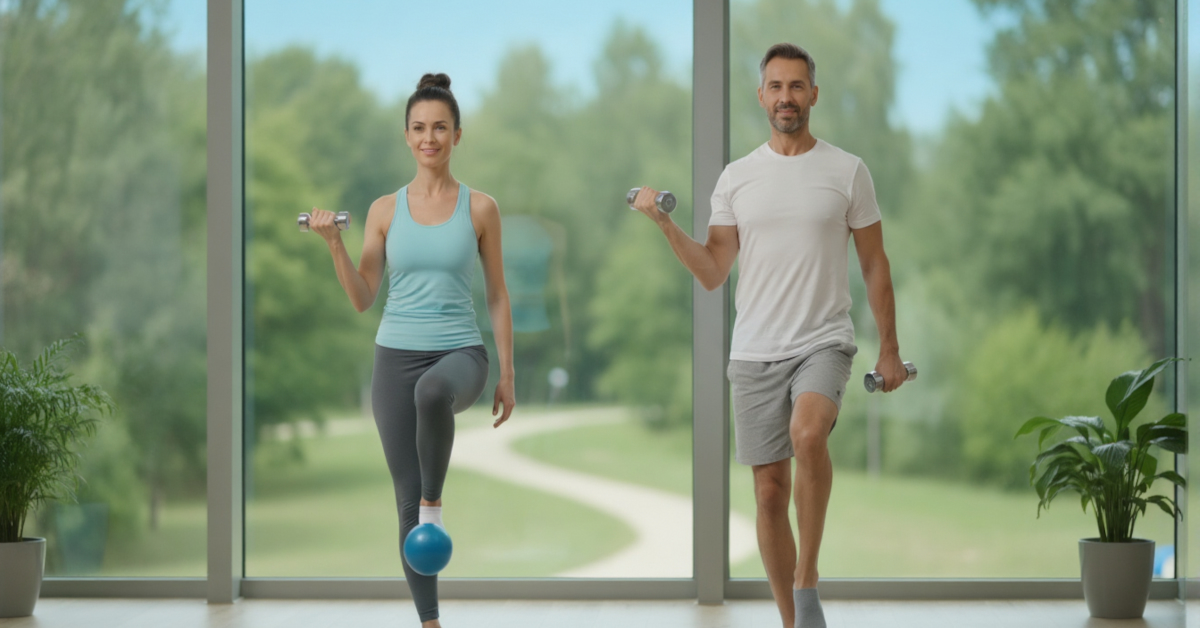
If you’re in your 30s, 40s, or 50s, you might notice a pattern: workouts that once felt “normal” now leave you sore for days, irritated in the knees or back, or just harder to recover from.
That doesn’t mean your body is “breaking.” It often means your training style and your life context (sleep, stress, work hours, sitting time) are changing at the same time.
This article breaks down what low-impact training actually is, what research and public health guidance consistently support, and why it can be a smart foundation for adults who want strength, stamina, and long-term consistency—without turning exercise into a recurring injury story.
What “low-impact training” means in fitness research
In exercise science, “impact” usually refers to the amount of force your body absorbs when you land, decelerate, or change direction—especially through the feet, ankles, knees, hips, and spine.
Low-impact training generally means movements that reduce abrupt loading and repeated pounding. Often, at least one foot stays on the ground, or the exercise is performed in a way that limits joint compression and shock.
Important nuance: low-impact is not the same as low-effort. Low-impact sessions can still be challenging, progressive, and meaningful for cardiovascular fitness and strength.
What the evidence consistently shows
Across public health guidelines and a large research base on physical activity, one theme is steady: regular movement is strongly linked to better long-term health outcomes, and the “best” plan is the one you can keep doing safely and consistently.
Low-impact can build cardiovascular fitness
Cardio benefits are not owned by running. Brisk walking, cycling, swimming, rowing machines, and elliptical training can raise heart rate, improve aerobic capacity, and support metabolic health—without repeated high-impact landings.
If walking feels like the most realistic option right now, you might also like why walking can outperform the gym for long-term health.
Strength gains don’t require impact
Strength is primarily about progressive challenge to muscles and connective tissue—not jumping. Controlled resistance training (machines, dumbbells, cables, bands, bodyweight) can increase strength and function while keeping joint stress more manageable.
For a practical overview of minimal, sustainable approaches, see simple exercise routines that improve long-term health.
Consistency tends to improve when pain is not the “price of entry”
Many people drop exercise not because they dislike effort, but because they dislike recurring setbacks—tendon flare-ups, knee irritation, back stiffness, or feeling “wrecked” after sessions.
Low-impact training can reduce that churn. In population terms, fewer interruptions often means more total activity across months and years—and that’s where many benefits accumulate.
Why this matters for adults 25–55
This age range is often a collision of responsibilities: long work hours, caregiving, commuting, stress, and less sleep than you’d like.
Recovery can feel tighter not because you suddenly became “old,” but because your recovery inputs are under pressure—sleep, time, nutrition quality, and down-time.
If your week is already intense, exercise that reliably fits (and doesn’t spark a week-long flare-up) can be more valuable than a “perfect” plan you can’t maintain.
Related context: sleep deprivation and why it changes how your body responds to stress.
Systems and environment: why “high-impact culture” can backfire
Modern fitness messaging often rewards extremes: hard intervals, daily intensity, “no days off.” But most adults aren’t training inside a recovery-friendly bubble.
Common reality factors include desk work, high screen time, inconsistent sleep, stress load, and limited time for warm-ups, mobility, and gradual progression.
In that context, high-impact training can become a mismatch—not inherently “bad,” but more likely to exceed what your body can comfortably absorb week after week.
It can help to think of fitness like infrastructure: your plan should match your real schedule, not your ideal schedule.
Best low-impact exercise options (with what they’re good at)
- Walking (flat, hills, incline treadmill): scalable cardio, easy recovery cost, easy to repeat.
- Cycling (outdoor or stationary): strong aerobic stimulus with lower impact loading.
- Swimming / water aerobics: very joint-friendly; useful when impact feels intolerable.
- Elliptical: running-like rhythm with reduced landing forces.
- Rowing machine: full-body work; technique matters for comfort and efficiency.
- Resistance training (controlled tempo): strength and resilience without impact being the main driver.
- Pilates / mobility-focused strength: core, control, stability, and range of motion for daily function.
What people commonly misunderstand
“Low-impact means it’s only for beginners”
Not really. Many elite and rehab-focused programs use low-impact modalities for high output (think: cycling intervals, rowing, progressive strength work).
“If it doesn’t hurt, it doesn’t work”
Discomfort from effort is not the same as joint pain or recurring flare-ups. In research and clinical practice, pain is not treated as a required signal of progress.
If inflammation and soreness feel like a recurring theme, you may find useful context in a plain-language look at inflammation and modern health.
“A perfect schedule matters more than a repeatable schedule”
Timing can matter at the margins, but repeatability tends to matter more. If you’re curious about timing without turning it into a rule, see what research says about morning vs. evening workouts.
Where evidence is limited or uncertain
Research can tell us a lot at a population level, but it doesn’t hand everyone the same “best” plan.
For example, higher-impact training is not automatically harmful. Some people tolerate it well, especially with gradual progression, good technique, and adequate recovery.
What’s less certain is how to predict, in advance, who will do well with repeated impact versus who will accumulate irritation over time. Past injury history, training volume, recovery, and biomechanics can all matter.
That’s why many coaches and clinicians emphasize matching training stress to recovery capacity—especially when life stress is high.
Big-picture framing: low-impact as “fitness you can live with”
Interpretation: Low-impact training is less about playing it safe and more about investing in a system you can run for years.
For many adults, the real win is not the hardest session. It’s the month where nothing derails you, the year where movement becomes normal again, and the decade where your joints still feel like they belong to you.
When stress is already high, it can help to zoom out and think about recovery inputs too—sleep, stress load, and nutrition quality. Related reading: what stress does to health (and what experts emphasize instead) and how ultra-processed foods can shape health patterns.
Conclusion
Low-impact training isn’t a downgrade. For many people over 30, it’s a more durable foundation—cardio and strength options that you can repeat without negotiating with your joints every week.
At the population level, the most reliable benefits tend to come from regular movement sustained over time. If low-impact helps you stay consistent, that’s not a compromise. It’s strategy.
Informational note: This article is for general education and does not provide medical advice, diagnosis, or treatment. If you have persistent pain, a medical condition, or concerns about safe activity levels, consider discussing options with a qualified health professional.